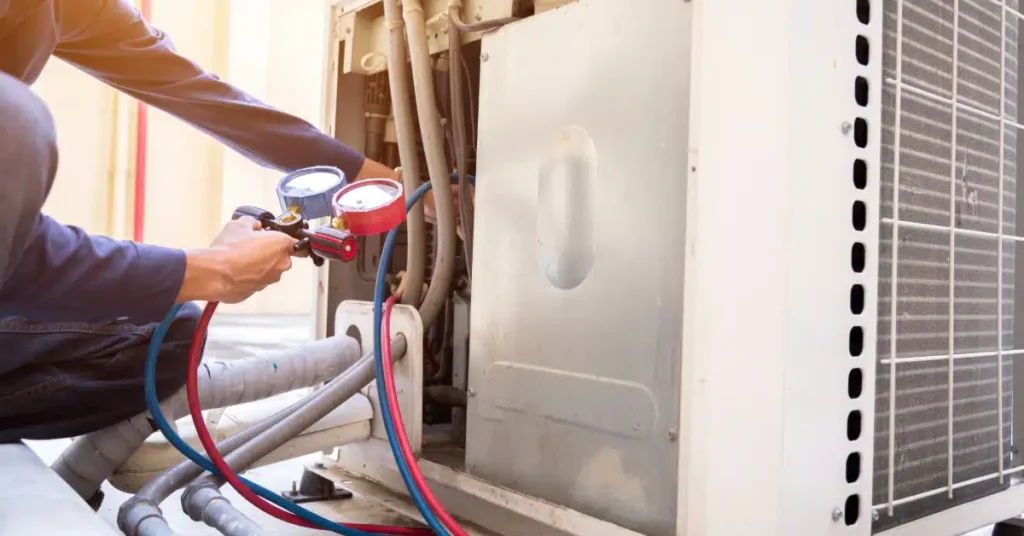
Air conditioner gas recharging is a technical process to restore the efficiency of air conditioners that have lost their cooling performance or are not working at all.
In many systems, from domestic split air conditioners to commercial systems and even vehicle air conditioners, it is necessary to refill the refrigerant gas that decreases or decreases over time.
In this article, you will find every detail, from the process of pumping gas into the air conditioner, the types of gas used, gas calculation according to BTU and safety warnings.
What is Air Conditioner Gas Charging?
Air conditioner gas recharging is the process of refilling the refrigerant (gas) circulating in the system in case of a shortage. This gas is the main component that provides the air cooling cycle of the air conditioning system. When the gas is missing, the air conditioner cannot function properly, it will not cool and the compressor may even be damaged.
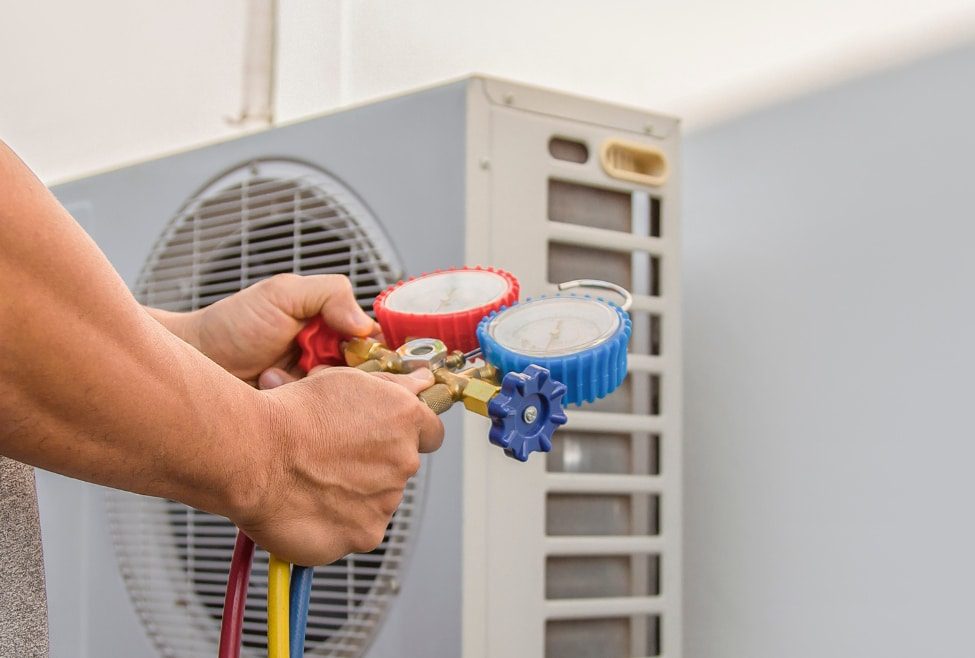
How Do We Know When the Air Conditioner is Out of Gas?
The air conditioner may need to be gassed in the following cases:
Signs Indicating Lack of Gas
Air conditioning works but does not cool
Blowing air is hot or normal
Icing of indoor unit pipes
Hissing sound coming from the outdoor unit
Compressor runs continuously but no efficiency
Types of Gas Used and Their Properties
R22 Gas
Common in legacy systems
Now banned for damaging the ozone layer
Not used in new systems
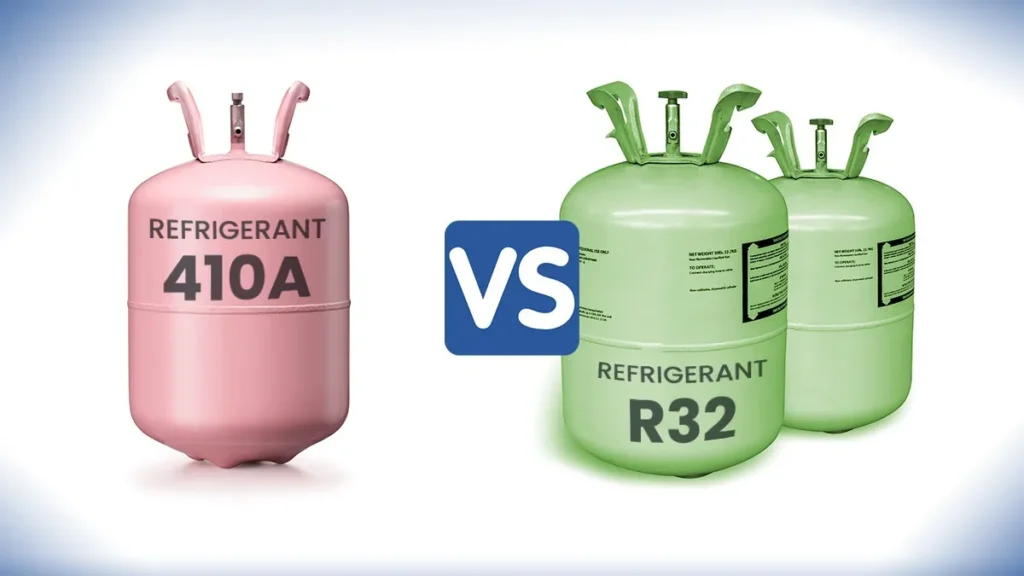
R410A Gas
Common in new generation split air conditioners
More environmentally friendly and efficient
Works with high pressure, requires special manifold
R32 Gas
The most up-to-date and environmentally friendly gas type
Single component, recyclable
One of the most energy efficient gases
How Many Grams of Gas Does the Air Conditioner Take?
Average Gas Amount by BTU
| Air Conditioner Capacity (BTU) | Required Gas Amount(gr) |
|---|---|
| 9.000 BTU | 700 – 850 gr |
| 12.000 BTU | 850 – 1000 gr |
| 18.000 BTU | 1100 – 1300 gr |
| 24.000 BTU | 1300 – 1600 gr |
Note:
These quantities are based on standard piping lengths. Approximately +20-30 g of gas may be required for each additional meter.
How to Calculate Gas for Split Air Conditioners?
The gas calculation is based on the air conditioner capacity (BTU), the pipe length and the type of gas used.
Connection Pipe Configuration
Standard length of connection pipe – 5m~ 7.5m~ 8m
Minimum length of the connection pipe:
For units with a standard connection pipe of 5m, there is no limit to the minimum length of the connection pipe. For units with 7.5 m and 8 m standard connection pipe, the minimum length of the connection pipe is 3m.
Maximum length of the connection pipe.
Maximum Copper Pipe Length Table for Split Air Conditioners
| Capacity | Max. Pipe Length | Capacity | Max. Pipe Length |
|---|---|---|---|
| 5000Btu/h (1465W) | 15mt | 24000Btu/h (7032W) | 25mt |
| 7000Btu/h(2051W) | 15 | 28000Btu/h (8204W) | 30 |
| 9000Btu/h (2637W) | 15 | 36000Btu/h (10548W) | 30 |
| 12000Btu/h (3516W) | 20 | 42000Btu/h (12306W) | 30 |
| 18000Btu/H (5274W) | 25 | 48000Btu/h (14064W) | 30 |
Method for calculating the amount of additional A/C gas oil and A/C gas refill
after extending the connecting pipe;
After extending the connecting pipe length by 10m compared with the standard length, you need to add 5ml of A/C gas oil for every additional 5m of the connecting
pipe.
How to calculate the additional A/C gas filling amount (based on the liquid pipe):
Additional A/C gas refill amount = extended length of liquid pipe x additional
A/C gas refill per meter
According to the standard pipe length, add refrigerant
according to the requirement as shown in the table. The amount of additional refrigerant filling per meter depends on the diameter of the liquid pipe.
Amount of Air Conditioning Gas to be Added for R32
| Liquid Line | Gas Line | meter/gram |
|---|---|---|
| 1/4” | 3/8” veya 1/2” | 16 |
| 1/4” veya 3/8” | 5/8” veya 3/4” | 40 |
| 1/2” | 3/4” veya 7/8” | 80 |
| 5/8” | 1” or 1 1/8” | 136 |
| 3/4” | – | 200 |
| 7/8” | – | 280 |
Note: If the outdoor unit is to be installed on the ground 5 meters or more above the indoor unit, an oil return pocket is required.
R22 Air Conditioning Gas – Cooling Mode Pressure Table (According to Outdoor Temperature)
| 🌡️Outdoor Temperature (°C) | 🔧 Suction Pressure (bar) | 🔧 Suction Pressure(psi) |
|---|---|---|
| 15 °C | 2.5 – 3.0 bar | 36 – 43 psi |
| 20 °C | 3.5 – 3.8 bar | 51 – 55 psi |
| 25 °C | 3.8 – 4.2 bar | 55 – 61 psi |
| 30 °C | 4.2 – 4.7 bar | 61 – 68 psi |
| 35 °C | 4.7 – 5.2 bar | 68 – 75 psi |
| 40 °C | 5.2 – 5.8 bar | 75 – 84 psi |
| 45 °C | 5.8 – 6.4 bar | 84 – 93 psi |
R22 Air Conditioning Gas – Heating Mode High Pressure (Discharge Line) Table
| 🌡️ Outdoor Temperature(°C) | 🔧 High Pressure (bar) | 🔧 High Pressure (psi) |
|---|---|---|
| +15 °C | 16 – 18 bar | 232 – 261 psi |
| +10 °C | 17 – 19 bar | 246 – 275 psi |
| +5 °C | 18 – 20 bar | 261 – 290 psi |
| 0 °C | 19 – 21 bar | 275 – 304 psi |
| -5 °C | 20 – 22 bar | 290 – 319 psi |
| -10 °C | 21 – 23 bar | 304 – 333 psi |
R410A Air Conditioner Gas – Cooling Mode Low Pressure Table (According to Outdoor Temperature)
| 🌡️Outdoor Temperature (°C) | 🔧 Suction Pressure(bar) | 🔧Suction Pressure (psi) |
|---|
| 15 °C | 5.5 – 6.0 bar | 80 – 87 psi |
| 20 °C | 6.5 – 7.0 bar | 94 – 102 psi |
| 25 °C | 7.5 – 8.0 bar | 109 – 116 psi |
| 30 °C | 8.0 – 9.0 bar | 116 – 130 psi |
| 35 °C | 9.0 – 10.0 bar | 130 – 145 psi |
| 40 °C | 10.0 – 11.0 bar | 145 – 160 psi |
| 45 °C | 11.0 – 12.0 bar | 160 – 174 psi |
R410A Air Conditioning Gas – Heating Mode High Pressure Table
| 🌡️ Outdoor Temperature((°C) | 🔧 High Pressure (bar) | 🔧 High Pressure (psi) |
|---|---|---|
| +15 °C | 25 – 28 bar | 362 – 406 psi |
| +10 °C | 26 – 29 bar | 377 – 421 psi |
| +5 °C | 27 – 30 bar | 392 – 435 psi |
| 0 °C | 28 – 32 bar | 406 – 464 psi |
| -5 °C | 29 – 33 bar | 421 – 478 psi |
| -10 °C | 30 – 34 bar | 435 – 493 psi |
R32 Air Conditioning Gas – Cooling Mode Low Pressure Table (According to Outdoor Temperature)
| 🌡️Outdoor Temperature (°C) | 🔧 Suction Pressure (bar) | 🔧 Suction Pressure(psi) |
|---|---|---|
| 15 °C | 6.0 – 6.5 bar | 87 – 94 psi |
| 20 °C | 7.0 – 8.0 bar | 102 – 116 psi |
| 25 °C | 8.0 – 9.0 bar | 116 – 130 psi |
| 30 °C | 9.0 – 10.0 bar | 130 – 145 psi |
| 35 °C | 10.0 – 11.0 bar | 145 – 160 psi |
| 40 °C | 11.0 – 12.0 bar | 160 – 174 psi |
| 45 °C | 12.0 – 13.0 bar | 174 – 189 psi |
R32 Air Conditioning Gas – Heating Mode High Pressure Table
| 🌡️Outdoor Temperature(°C) | 🔧High Pressure (bar) | 🔧 High Pressure(psi) |
|---|---|---|
| +15 °C | 28 – 30 bar | 406 – 435 psi |
| +10 °C | 29 – 31 bar | 421 – 450 psi |
| +5 °C | 30 – 32 bar | 435 – 464 psi |
| 0 °C | 31 – 33 bar | 450 – 478 psi |
| -5 °C | 32 – 34 bar | 464 – 493 psi |
| -10 °C | 33 – 35 bar | 478 – 508 psi |
How to Calculate Gas in VRF Air Conditioners?
In order to charge additional gas to Vrf Air Conditioning systems, the total liquid line of the copper pipes drawn in the system is collected. Each pipe diameter has a (kg/m) value. Pipe diameters are multiplied by these values separately and summed.
Additional Gas Charge Calculation Table
| Liquid line | Additional gas(kg/m) |
|---|---|
| 1/4 | 0,022 |
| 3/8 | 0,054 |
| 1/2 | 0,11 |
| 5/8 | 0,17 |
| 3/4 | 0,25 |
| 7/8 | 0,35 |
For example, 150 meters of liquid line was drawn in a Vrf Air Conditioning system. 50 meters of 1/4, 50 meters of 3/8, 50 meters of 1/2
50×0,022= 1,1
50×0,054= 2,7
50×0,11 = 5,5
5,5+2,7+1,1= 9,3 The amount of gas to be added to the system is 9,3 kg.
If the outdoor unit does not have gas, it is added to this calculation according to the label value on it.
How is Air Conditioner Gas Charging Done?
Step-by-Step Air Conditioner Gas Refill Process
- 1. The outdoor unit covers are opened and the manifold set is connected
- 2. Vacuuming is done (air and moisture are drawn out)
- 3. The required amount of gas is weighed and printed with a precision balance
- 4. Leakage control is performed
- 5. The device is started and tested.